Showing posts with label Wifi. Show all posts

Thursday, April 20, 2017

Sailing Cuba


Marina Hemingway, Havana, Cuba
After more then two years in the Island Yacht Club Marina in Clearwater Beach, Florida, Earthling casted off the dock lines and sailed away to the Caribbean again. Aboard are the crew, Jim, Johnny, and the captain, George. The 190nm passage from Clearwater to the Dry Tortugas was smooth, with calm seas, and moderate winds. Tortugas is such a unique island, there is a hexagon shape fort build in the 1800’s on this little land. If you ever find yourself in Key West, then it’s worth a visit to take the ferry or the seaplane to Fort Jefferson in Dry Tortugas.
The Sea plane landing next to Earthling
Fort Jefferson
From Dry Tortugas to Havana is around 100nm, but you have to cross the Gulf Stream and it’s important to watch the weather. Large confused waves were encountered but for most of the part, that passage went fine as well. One over-night and in the morning we saw the buildings in Havana. It feels good to see Havana after so many years that Earthling have been wanting to sail here. Marina Hemingway is the first port of call. It is located 9km west of Havana. The Marina is fairly large and most of it seems like it’s not being used.  It’s a good place to land for sailors, since you get to meet many other cruisers from around the world. Earthling became good boat buddies with the Brazilian family aboard “Coragem” and the Hawaiian family aboard “Lōkahi”, among others!   

Marina Hemingway

When you step foot in Cuba, it feels like the country was frozen 50 years ago, from the cars to the buildings. I’ve never seen so many beautiful worn down buildings in one place. These houses have well architecture but most have not been restored since long time ago. The houses that are renovated are usually with the financial support of family members in the U.S. Most fascinating which put you back in time are the cars, all these American cars from the 50's and a the Russian Ladas. Cars are very expensive. Even the old beaten down cars are worth thousands. Majority of newer cars are company owned and most companies are controlled by the government! People take public transportation, walk, or bike. Biking is the way to go here and this foldable bicycle aboard Earthling took the Captain all the way to Havana and back with some sighting around the city in one day!    


A house in Havana
Every old car works as taxi
Cubans like many other Latinas are happy, friendly, and upbeat. They like their music, they like to dance, and party. In general, they are all educated, but less people speak English and adventures travelers to Cuba should know at least some basic Spanish. It is very strict here and you are being watched even if you think you are alone in the middle of nowhere! Along the coasts, there are watchtowers that monitors who is navigating the Cuban Waters. Most Cubans fear their government and follow the law and talk very quietly about politics! Still to this day, Internet and phone services are very underdeveloped. You will be able to find Internet hotspots in hotels and parks, but talking over Internet is almost impossible, a VPN service might be a good solution! Morover, you have to purchase "etesca" one hour internet cards in order to access the WWW. It happened several times where we asked for wifi, and yes there is wifi, but it’s not connected to Internet, or it's the weekend and the internet is off! It’s also possible to get a local mobile sim card, but be aware that it cost $2-3 a min to call that number from outside Cuba. 
Johnny is mingling with the locals
When in Cuba, you must more or less negotiate everything. Salaries are very low and Cubans look at tourist as a way of making money. A doctor in Cuba makes around US$40 a month, which is a high salary. Although, education and medical are free for everyone, but a dollar a day is not much! A can of soda or beer is $1. One CUC is equal to $1 but if you are exchanging the U.S dollar bills in Cuba, you get only 90CUC for $100. You get more value for your money if you carry other currency such as Euro! There is also a second currency, the Pesos ($1=25pesos), which is used mostly for basic food, public bus, etc. Visitors usually don't deal with the second currency! Remember that many things cost more for tourist than for Cuban’s. The first taxi ride in the old Plymouth from the Marina to Havana cost us $15 and the last taxi ride cost $8. For example if you want to buy 30 eggs in the Marina, it might cost you as much as $30, but if you go to the market with a local person, it will be around $3. We were fortunate to be introduced to a local person here; Armando was kind to help the crew with groceries and other chores that would have been very difficult otherwise. You can always taste and feel the country and the culture much better, whenever you are with locals. We were invited to a few Cuban homes and experienced a wonderful time. Unfortunately, Armando was not allowed to come aboard Earthling. It’s strictly forbidden for Cubans to come aboard foreign vessels, since that’s a common way of escaping the country.

Armando and George
Furthermore, keep calm when almost everyone you are confronting in the Havana area is expecting and asking you for something, a drink, food, your hat, etc! One day the security guys asked for something to eat with their rice, so they got some ham from Earthling. They walked by “Lōkahi” and asked if they could have something to eat with the ham, so they got some bread. The best approach is to respectfully refuse, otherwise you might give your boat away!
Moreover, it’s very safe in Cuba and crime is low, the punishment for stealing could result years in the prison! And apparently it’s very easy to go to Jail!

It’s wise to be well provisioned when you are cruising these waters because not everything is available in Cuba. There are more empty shelves than full ones in most convenience stores or the pharmacy! Cuba is the biggest Island in the Caribbean and by distance very close to the U.S. But it seems too far away since it's so different. This country has great potential for more tourism and finance. It is changing, but very slowly!  

Where can you find an old classic convertible as a Taxi
Flower Cart in the streets of Havana
Houses in Old Town Havana
A military funeral in Vedado
Square in Old Town Havana

Streets in Havana
1956 Chevy at the Marina
The Contrast of Mega yachts and old cars
Gold is a big show here (Local Pool Party)

Little hotel and restaurant in Havana
Got Taxi
Old cars broken down on the side of the road is a common scene!

Biking by different neighborhoods around Havana

There are not much traffic in Havana
Jim is leaving in the taxi to the airport


To see more pictures, visit the full album on the facebook page, Click here!

Thanks for reading
Love and peace from Havana, Cuba

Tuesday, July 23, 2013

Kuna Yala


Sailing Ulu by Achutupu
Kuna Yala is the land of Native Kuna Indians, also known as San Blas. This area stretches around 150 miles along the South Eastern side of Panama. Kunas live very original, the most primitive I ever witnessed.  Their homes are made with bamboos from the jungle, majority don't have electricity or running water, and bathrooms are outhouses over water. The men paddle "Ulus" (Dugout canoes) toward the rivers on the main land early in the mornings and return with supplies throughout the day. They get their water from the rivers, vegetables and fruits from the main land in the Darien forest, and meat from the sea. The only signs of modern world are radio antennas, a few outboards, and mobile phones, which is more evident in the northern villages than southern. The first language is kuna and Spanish is widely practiced. There are around 360 islands in San Blas and most are not occupied. Villages are usually located close to the main land and well populated.
Supplies from the forest
Ustupu
Achutupu
Women paddling to the river to get water
Isla Tigre
Typical view of a village with Darien Jungle in the background
A school's bathroom in Ustupu
Homes out of bamboo
Kuna Yala is a woman dominant society. Women make most important decisions, they choose their husbands and manage financials. In Hollandes Cays, a gentleman came over to greet us. First thing he asked was if there was a woman aboard? Yes, and Katherine came out on deck. Thereafter, he talked to Katherine about anchorage fee and handed her a note in english. I'm standing there and watching and this guy doesn't even look at me till he got his $10 and gives a receipt, only then he turned around and started chatting with me.
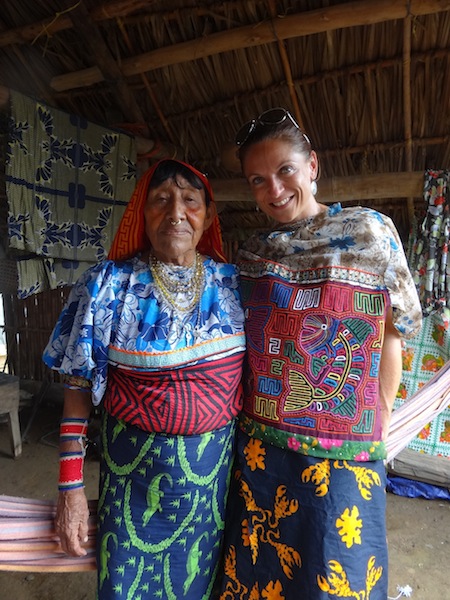
Women dress in tradition clothing called Mola, which is the primary art Kunas offer.
They are sewn patterns of nature on different colors and layers of fabric. Molas are a famous hand craft of Panama. Some molas are definitely a piece of art and great souvenir and gift for friends and family. Usually Kuna women row up on their ulu to the cruising boats and offer the handcrafted molas for sale.
Estelfina invited us to her house to see her molas
Mola stand
Kunas like to give visitors gifts (Regalo). We have got seafood, fruits, molas as gifts from various locals. However, one experience has been making me a little cautious with taking gifts. In Ustupu, a happy person, Ricardo rowed on his ulu up to Earthling and sold us bananas & mangos. The following day he came by & offered fruits again but we already had some and were not interested. But Ricardo insisted to take some as Regalo because we were amigos. Ok, gracias amigo as I took four mangos. Ricardo said; De nada, Un Balboa($1)! I wasn't going to get into the definition of Regalo with Ricardo with my broken Spanish, so No problema, A dollar for you amigo :-)
Kind giving locals in Isla Tigre
Lobster or Lancoste
Ricardo brought fruits by every day
Kunas are peaceful and in harmony with nature and they would never hurt anyone. They don't lie, cheat, or steal. They are trusting and we never felt it was necessary to lock the boat. The Kunas in the southern islands have had little interaction with outsiders and seldom might not come across as friendly as others. Some individuals from previous generations might not really be excited to directly interact with visitors. And it makes sense, since Kuna Yala has been threaten by outsiders several times in the history. Originally the Spanish tried to rule it and then the Panamanians. Furthermore, people dug for gold in their rivers and the drug trafficking of rootless people have not left a good impression in Kuna's mind. Fortunately the only people that left better imprints are the sailors and cruisers and once they hear you are on a sailboat they soften up. They have been violent twice throughout the history, stood up for their land and fought first with the Spanish a few hundred years ago and second with Panamanians in the mid 1920's. Where they even massacred the interracial Kunas. Their new flag symbolizes both of the fights.
Wichubhuala


 Some villages are like a labrynth, we got lost in Achutupu, Earthling's mast is visible in the middle of the pic, but how do we get there
Ustupu, largest Kuna island
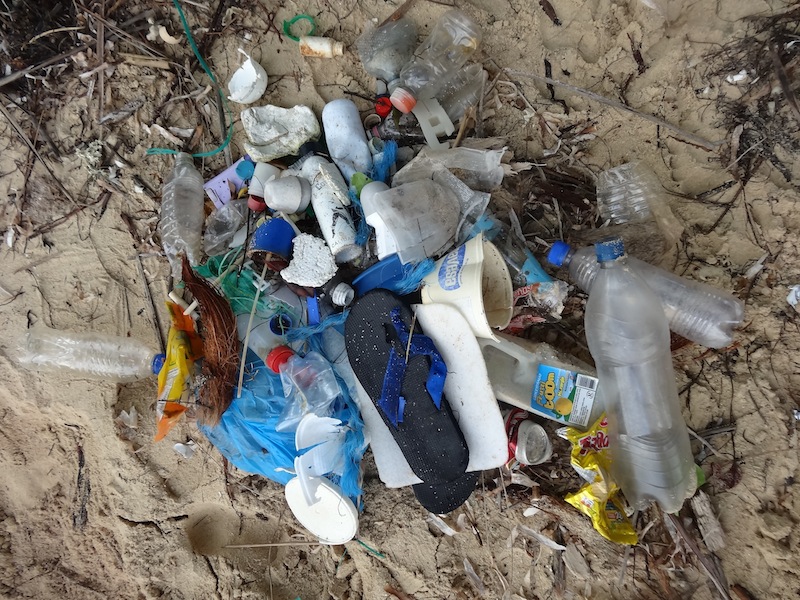
Kunas are known to take care of the nature and maintain it clean. Nowadays one can't go by without noticing plastic, metal cans, and glass floating on the water around villages and stacked up along the shores, a sad scene in paradise. The other day we payed attention to a person that walked up to the sea and threw all the trash in the water (it's common). Many of the trash was food rest and degradable, in addition there were plastic soda bottles and thin cans. It's not really the person's fault, she has been throwing rubbish into the sea for 70 years and it always disappeared but today it doesn't just go away and it could be because of the evil spirit. Could the evil spirit be the corporations that mass produce & export cheap products around the world? That is a political discussion for itself. In a perfect world if we are producing materials that would not disappear in nature, then it's our responsibility to educate our peer. I think most if not all packaging materials should be degradable.
There are many deserted islands in Kuna Yala. Before getting back on the more common cruising route north of Rio Diablo, Katherine and I got to spend an amazing evening totally secluded on Farewell Island. This little island was resided by 100s of palm trees of different sizes. The hammock was set up in between two of the trees on the beach with a Bonfire next to it under the full moon. Every time we set up a fire, our trash gets burned, in addition we try to clean up the surrounding of all plastic materials and burn them as well. In the Farewell island we burned tons of plastic bottles that were floating on the beach and in the water.
Since the first bonfire in Chub Cay, Bahamas, I learned from Ali to have a clean bonfire without leaving any evidence. First dig a deep hole in the sand on the beach, create the fire and when it's over, put it out with water, and then cover it totally with sand without leaving any kind of foot print. That way the nature is back to its original shape and beauty!

Farewell Island

Trash collected on the beach
If you are depended on Internet and planning to cruise the remote islands of Kuna Yala, plan a head for some other solution since it is more or less impossible to find Internet. I must add that all the schools in the populated islands have Internet but it might be difficult to access it at all times. We have gone to schools and tried to use the Internet, sometimes the weather has been cloudy and the solar panels couldn't put out enough energy to turn the modem on, other times there are so many kids with their small laptops that the speed can be slower than dial up, another time we had to go to school director's house and see if he could let us use the Internet, he said in half hour, after half hour we were informed that Internet wasn't working that day.
In Ustupu, you can find wireless Internet by the the airport at the power plant, additionally there is a wireless Panamanian network that occasionally works on a very low speed in some islands like Nargana by Rio Diablo. In other islands like Achitupu there should be Internet at the Hostels but the hostel was closed. The only reliable wifi is on Elephant island in West Lemmon Cays.
This is the path to the electricity plant by the airport in Ustupu, in search for wifi
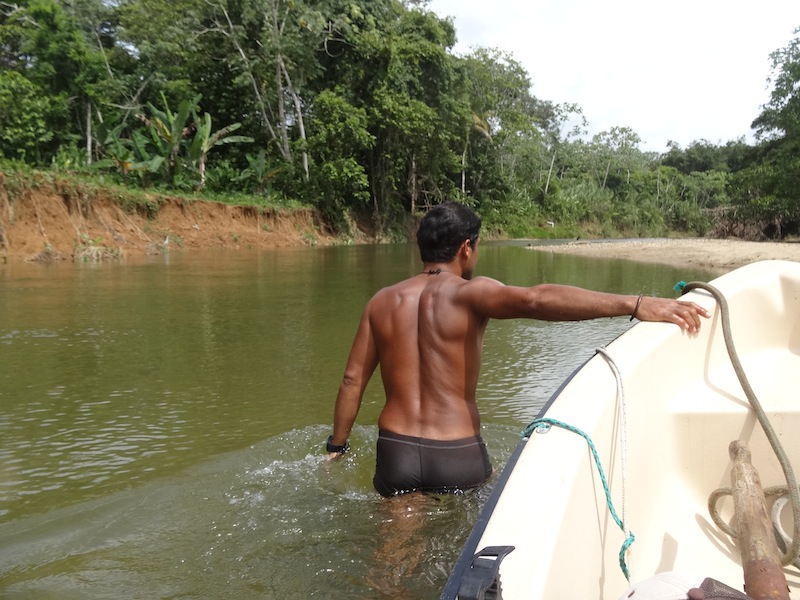
One rewarding adventure has been rowing up and down the rivers. There are tons of rivers in Kuna Yala. The mouth to most of the rivers is shallow since debris, and tree logs get stock there, making it difficult for dinghies with outboards to enter. Once up the rivers you can find mango trees and load up with mangos. furthermore, the Kunas have their cemeteries on land by the rivers.
Cooling down and towing the dinghy in Rio Diablo
Nargana
 Local teenagers we met on the river
Kuna graves
Large tree trunks in the water, always keep an outlook to avoid them
Earthling cruised in San Blas for five weeks and anchored in seventeen different places from Isla Pinot on the South to Provenir on the North. 

Love from Kuna Yala

View more pictures on fb page

Saturday, December 17, 2011

St. Martin

It’s surreal to be in France after a night passage from St. Croix. The mainland of France is far a way from here, but you get the taste of it in St. Martin. You see Citroens and Peugeots, which make it European and feels like home to me. The fresh smell from bakeries making baguettes and croissants is wonderful. Moreover, French wine is present everywhere and all you want to do is drink slightly cooled Chardonnay during the warm sunny days and Bordeaux at night. The radio stations play great music here and the locals dress more tastefully in this part of the Caribbean. Nevertheless, this Island is not only french, it’s also Dutch. We entered St. Martin on the French side, Marigot, since it’s a few Euros cheaper to check in and out here and there are no anchorage fees in most sites. As most of our followers and friends know, this adventure is happening with very limited resources. This Island is less than 50 square miles and it’s easy to dinghy, walk, or bike from the French to the Dutch side. There is a lovely story about the division of this island. It is not supported by historical fact, but according to Chris Doyle’s Cruising Guide, “The French and Dutch were so civilized that, rather than fight over the island, they had a Frenchman armed with a bottle of wine walk in one direction and a Dutchman equipped with a flask of gin take the other. Where they met became the boundary, and the French ended up with a bit more because the gin was stronger than the Wine”.

The 92 mile night passage from St. Croix to St. Martin was smooth. The heading was 92 degrees and wind NE at 6-10 with moderate seas. We sailed on a close reach all the way to Marigot. Being strictly under sail going East in the Caribbean is very rare, because of the trade winds. But we were very lucky with the weather window. This was the first night passage for this leg and we were missing the tranquility. To most people it might be frightening to be on the water in the dark, where you can’t see anything but the sky. Even so, there is a feeling involved with this experience that is exceptional. Being alone in the middle of nowhere under darkness brings you closer to your higher self! It’s great meditation time. A few hours after total darkness, where we couldn’t even see the water, the almost full moon rose with enough light to see the swells and still all the stars. Nonetheless, you can’t wait for the sun to rise and bring light to all!

One of the difficulties in a cruising life style is access to information. In other words, lack of internet. We forget how comfortable we have it on land. When you live in a permanent place, it’s easy to have access to internet endlessly, but when you are traveling from one place to another in different countries, it’s impossible to have internet at all times. Mostly, we find wifi signals from the boat with an antenna, still most are locked and sometimes you can purchase the password. What we usually do is to go ashore to find wifi in a bar or coffee shop and that requires that you purchase something to be able to use the wifi.  It requires time and effort to have a blog update or post pictures and keep in touch. So please don’t be worried and be patient if you don’t hear from us every few days or so. One amazing device aboard now is the spot connect. Anytime we set sail, the spot connect will be activated and keep a track of Earthling’s passages and actual location. We are looking forward to the day where internet wifi covers the whole planet free of charge for everyone.      
Love from St. Martin