Thursday, April 4, 2013

Cartagena


Since Earthling set sail from Miami in Feb 2011, we have been hoping to more than 40 islands. The biggest islands being Dominican Republic and Puerto Rico. However there were all Islands. Here in Colombia we have finally arrived the main land! There are lots of people and cars everywhere, the cities are bigger and distances between them far. Colombia is the 2nd most populated country in the latin America. And Cartagena with a population of around 1million is the biggest city we anchored off since Miami. This is my first time in South America and so far I love it and would like to explore more of it.

Yellow Dot is Earthling
Earthling is anchored in the middle of the port of Cartagena with a 360º view of the city. Boca Grande on the west, Old Town on the north, Manga on the east and the ship container yard on the south.
Most high rises are in Boca Grande, where upper class Carthaginians live in addition to many tourist that stay in the big hotels. On the main street in Boca Grande you will find all the fast food chains and many other smaller restaurant. Boca Grande is compared to Miami and it has a similar vibe. The entire area is surrounded by water, on the east side there are good paths for running and roller blading and on the ocean side are the long packed beaches, which doesn’t come close to south beach but pretty for themselves.
Our north view, "Centro El Historico" (Old Town) or the walled city goes back 500 years. There is actually a wall surrounding the historic city and the old town is considered a world heritage site. El Centro is the prettiest part of greater Cartagena. There are zillions of boutiques, street vendors, hotels, and restaurants among beautiful colorful historic constructions.  
Boca Grande and Old Town are highly surveilled by security and police. We are anchored by Manga in between Club Nautico and Club Pesca. Manga is also a nicer part of Cartagena. The actual populated city of Cartagena is a few miles away, which I have just taken the bus through to the terminal. Mostly I bike around El Centro, Getsemani, and Boca Grande.

The Wall around Old Town
Street Vendors
Last week I made an attempt to hike to the top of the highest hill “Cerro De La Popa”, but we were informed by the police and others that the hill is surrounded by different gangs and hiking up would not be safe, specially at night. 
All my visitors are gone now. Hector was aboard for 27 days, he left back to land life in Chicago. My good Colombian friend Paola that I know from Chicago visited from Valledupar for the easter week and it was a pleasant reunion. I always enjoy to have friends and visitors aboard, however I like to spend time alone as well. When you have company aboard you are less free and you have to think about crew’s well being and happiness. Now I’m solo here and my boat buddy Marius on “Chiron” is 100 feet away and we have to learn Spanish.
Hector, Paola, Marius and I on the historic wall
Marius just bought a hat
Hector in front of Gertrude Statue
Paola and Earthling in the background

Street Corners of Old Town


Love from Cartagena
View the complete photo album of Colombia here 

Friday, March 22, 2013

Cruising Colombia


Cruising and boating in Colombia is becoming more and more popular. Many Marinas have been built in the last few years and new ones are in construction. Earthling was docked at Santa Marta Marina (IGY) for 11 days, which is too long for us being tied at a dock, but we had a great experience. STM Marina is located perfectly by the city and is one of the nicer marinas in the area. It’s just a couple years old and getting more completed; a marine store, restaurant, bar and haul out facility will be available at Santa Marta Marina in the near future.
In order to promote boating tourism, the Ministry of Tourism of Colombia recently published a “Cruising Guide to Colombia” in English. The book contains detailed marine charts of the Atlantic and Pacific coast of Colombia including all the Colombian Islands, anchorages, and many additional information. It’s not written by a cruiser or a boater so it might not be as comprehending as other cruising books, but is definitely a great source for sailing these waters! As of yet the book is not available to purchase anywhere, but you can get a free issue in Santa Marta Marina if you are nice to Diana at the front desk. They do as much as they can to help and provide a good experience for sailors, but Colombia is still developing and boating is a pretty new culture!  
Santa Marta Marina


One challenging issue for cruisers to visit Colombia is the check in & out procedure. Since Earthling landed here, there has been confusion on how much we have to pay for what! All the different agents we interacted with, have been nice but I don’t speak Spanish and although my crew Hector is fluent in the language, it still has been really hazy to understand the rules and costs. The laws and rules for cruising boats are still the same as cargo ships. Every time you come in or leave a marina or anchorage, you have to check in and out through an agent. The price to hire an agent in Santa Marta is $100US, and in Cartagena between $60 to $100. If you stay in the country more than a week, you have to apply for a 90 day temporary importation of your vessel, a fee which could be included in the total $100 or the agent might charge you an additional fee of $103 (185,000Pesos). Furthermore, in Cartagena you might need to pay for a cruising permit if you are staying more than 10 days. All these rules make visiting Colombia relatively difficult for cruisers; it’s expensive, confusing, and too much of a hassle. Additionally, your agent might tell you it’s easier to take a bus to Cartagena, costing less than sailing there and going through the check in procedure. My understanding is that “Samarians” (people from Santa Marta) would like you to stay in their home town! If you want to visit Cartagena, sail your boat down and view the city entering it from water, pay the additional $60 to check in with the port captain and you are all set. The Authorities are working on making laws easier for pleasure crafts to visit Colombia, but in this country as with many other developing countries in the world, it will take time to enforce new laws and regulations.
 
All that said, small vessels like Earthling fall into a grey area. Sometimes we have to find an anchorage because of the weather, or on occasions, we want to anchor in the next bay or an island nearby! I have not heard of anyone getting in trouble and locals move around all the time without checking in and out. If there are no agents or offices close by, you are ok! In Santa Marta we hired Rafael from Agencia Maritima, whom speaks very little English and in Cartagena we hired Manfred, whom is fluent in English. We payed $100 to Rafael to check in the crew and the boat including temporarily importation and in Cartagena $60 to check the boat in with the port captain.  
The key is to be patient and not get frustrated. It is easier said than done but with kindness and patience you will get much further for less price! 

Once in Colombia, you will encounter and see many police, coast guard, and security. This is one of the solutions to reduce the crime in the country. Colombia is much more secure than it use to be 5-10 years ago, but crime still exists and a traveler must keep a low profile so as to not stand out.   

Colombia is a beautiful country that has much to offer and well worth the visit. In Santa Marta we were able to visit Minca, which is in the mountains 45 min from the city. Adventurous travelers can stay in Minca for a few days and hike up to the lost city, visit the coffee plantation, the Indian village, or my most favorite attraction, waterfalls. Furthermore, on the northern part of the country you can visit Tyrona National Park, where if you climb high enough (+20,000ft) you will step in snow. We didn’t get to do that during this trip but it’s on the list of things to do next time Earthling visits Santa Marta. 


Upper Water Fall in Minca 
Lower Waterfall
Beautiful Flowers


Love from Colombia

Monday, March 11, 2013

A Fish Full Passage

Another 270 mile passage brought Earthling to Santa Marta, Colombia. This leg delivered many fish to our boat! We were fortunate to catch a good size Mahi Mahi followed by two Tunas, in addition to 21 flying fish that landed on deck. Literally we caught a fish every time the line was put out in the water!
Mahi Mahi
Tuna
Flying Fish
 The passage from Aruba to Santa Marta can be tricky, it’s important to watch the weather before setting sail, specifically the wave transformations. One of the sources is weather passage. In the map below you can see how Atlantic and Gulf of Mexico currents can interact by Colombian coast. It would be wise to avoid finding yourself in the middle of 10 footers crashing against each other! Timing was perfect and we did not run into any of that!
Wave Directions, Source: passageweather.com
The passage was divided into two 135 mile legs, Aruba to Cabo De La Vela and further to Santa Marta. The first leg was calmer and easier than the second one. Once you leave Cabo De La Vela to Santa Marta, you will be in Shallow waters (100-200ft) and the waves can build up close to each other, which makes running down wind more or less challenging. With winds of 15-20 and swells between 7-10ft at 6-7 sec, the autopilot could not hold and we had to mostly be behind the helm. My crew/friend, Hector, does not have much sailing experience but he got to steer and can manage being behind helm during day time now. I had to stay awake most of the night! I was tired and desired a power nap after midnight. During the first attempt to get a nap while the auto pilot was engaged, as soon as my eyes were falling asleep, a flying fish landed on my face, scaring the heck out of me! I could hear the fish flapping around in the cockpit, and in this cloudy moonless night, it was a fun game to catch the fish and throw it back in the water! The second attempt for a quick nap was followed by a nice fresh cold splash of salt water on my face from a large swell hitting the stern of the boat. I guess the universe was trying to say, “Stay awake!”
Cabo De La Vela N12º11.77 W72º9.30

Ensenada Gairaca N11º19.31 W74º6.45


Once the sun rose, the tall mountains of Colombia appeared like we entered a new world, the best sight you can imagine after 10 hours of darkness. The five bays between the mountainous nature were looking so attractive that we had to change course to go in one (Ensenada Gairaca). The breakfast rest and a swim was perfect liberation before going to civilization in Santa Marta. These bays are beautiful deserted anchorages that should not just be passed by. The last bay before Santa Marta is Taganga, where we biked to on Sunday. The beach is mostly visited by local tourists and the hippie society. There are many small restaurants, shops, and handmade jewelry street vendors.
Santa Marta in Sight
Sunset by Taganga Beach
Taganga Beach
Earthling is docked in Santa Marta Marina (IGY) for now and will be cruising Colombia for another month till my Spanish gets more ground. We are planning to cruise the coast down to Cartagena and also travel inland to see more of Colombia.             

Love from Santa Marta

Click here to view the Album of Colombia

Sunday, March 3, 2013

Danki Dushi Aruba

Days flies by when you have good times with friends. I did not think about staying in Aruba for three weeks, nonetheless it has been a pleasant visit. You know you have been in one anchorage too long when; you recognize most of the boats around and every time you step ashore people know you by name, then it’s time to move on! The longer you stay in one Island the more convenient it becomes, you know where things are, where to go and you find new friends. However, the main reasons Earthling has not moved in three weeks is the weather. There will be a weather window on Monday and Tuesday with calm seas and moderate wind and we have to jump on it to sail to Colombia. The passage from Aruba to Colombia is considered to be very challenging. It is rated as the fifth most difficult passage in the world. Swells and currents from the Gulf of Mexico and the Atlantic ocean can collide and create large sharp seas. We shall wait and see in a couple of days.
California Light House
The Old Fort on the Windward
Sunset by Arashi Beach
Aruba is a great hub for friends and family to fly into. My friend Nick flew in on a non stop flight from Boston last week. It is nice to have old friends aboard, Nick’s visit was a great reunion. We rented a car and explored the Island. The highest elevation is 175m/600ft and there are steps on the side of the hill going all the way up, it didn’t take long to go up and down and the best view of the island could be viewed from here! We also drove through Arikok National Park to the windward side where there are a few very cool caves worth seeing. The drive through the national park and the North side of the Island is scenic and it is a fun ride on dirt roads along the windward coast. On the Leeward are the “High Rise Hotels” along long beautiful beaches such as Palm Beach, Eagle beach, and Manchebo Beach. At the most Eastern corner is Arashi Beach, where locals go to and the California sand dunes and Lighthouse are just around the corner.
View of the Tallest Hill
View from the highest Point
Nick is pointing at the Pinnacle
The Light Shall Set You Free
Guadirikiri Cave
Stock up Reef Rocks and make a wish, lots of wishes must come true here
As of a couple days ago my friend Hector joined Earthling. He will be aboard till Cartagena, Colombia. Hector is fluent in Spanish, which makes communication easier in a Spanish speaking nation. Earthling’s boat buddy S/V “Chiron” is also here and we will be making the passage alongside each other.

In Papiamento
Danki=Thanks
Dushi=Sweet

View the complete Album of Aruba on fb page, click here

Follow Earthling’s crumb trail from Aruba to Colombia on spot connect       

Love From Aruba

Thursday, February 21, 2013

Aruba Arriba


Another overnight, 200 mile passage brought Earthling to Aruba from Los Roques. She sailed with a full Genoa the whole distance. Unfortunately we didn’t get to stop at the other Dutch, ABC Islands, Bonaire and Curacao, since Katherine had to catch a flight back to the U.S from Aruba.
Grand Plaza

As we were approaching the South Eastern side of the island, in sight were industry and oil refinery. Close to the airport, there was a big smoke and it was the waste land fill. That’s not how you would imagine Paradise! Nevertheless, Aruba has a well known name, it’s like a brand! This Island is wealthy in it’s natural resources. First gold and then black gold, oil, was discovered in Aruba in mid 18 and early 1900s. It has been the major income of the island up till 30 years ago, when tourism took over and it’s the main industry today. Arubans are smart and very good at promoting their island. It’s one of the most recognized vacation destinations in the Caribbean. There are tourist from all parts of the world, mostly South and North Americans and Europeans. Earthling is anchored right by the airport in Oranjestad, small and large airplanes are landing frequently from everywhere. And then there are cruise ships, in and out daily. The cruising community is not big here, and protected comfortable anchorages are very few! The only place to check in with immigration and custom is at Barcadera port and it’s free. But if you decide to stay here more than five days, you have to hire an agent to declare your vessel, which can all be done at Renaissance Marina’s office for total of $70.
Pinchos Restaurant & Bar on the pier
Iguanas are Common in Aruba

The people of Aruba are rich in their culture. People from Netherlands have always amazed me of how open minded and accepting they are of other languages and cultures. Aruba belongs essentially to Netherlands, but Arubans can be white, black, Asian, and Hispanic and the mixture of all. Everybody speak Dutch, Papiamento, Spanish, and English. Papiamento is the local language of the ABC Islands. On FM101.7, I hear mostly Papiamento or Dutch but with a twist of Spanish and English. It’s amazing! I shouldn’t feel bad Mix and Matching Farsi/Swedish/English with some people, like my high school friend Nick. Who is flying in from Boston today for a few days.

Aruba is a relative flat small Island. Usually flat Islands have beautiful beaches. And along the long sandy beaches on the Northwestern side are all the hotels and plenty of good restaurants and bars.  

Since we arrived Aruba, the wind picked up and it has been blowing constantly 20-30kt. The predictions for the next seven days are the same, so Earthling will stay put here till the wind and waves come down before sailing to Colombia.

Love from Aruba

Friday, February 15, 2013

Deserted Paradise, Los Roques


Just a Little Patch of Sand is All You Need to Be Happy
This is one of the wonders in the Caribbean well worth to visit. This place is like the big brother to Tobago Cays. In the Los Roques National park, there are 300+ small islands, sand dunes, and patches of land in the middle of nowhere. You can find hundreds of deserted anchorages, where you snorkel off your boat and explore underwater world. This is a remote destination for wealthy Venezuelans, there are no ferries or cruise lines, the only way to get here is to fly your personal jet or take one of the small airplanes from Caracas or Margarita or the Earthling sailor way. This place is so untouched that one could wonder around for a long time before getting tired. In matter of fact next time my path goes by here, I will spend an extended period goggling around Los Roques.
Socialists with private jets, hmm!?
Venezuelan Yachters
The Lagoon Anchorage
It was nerve-racking to enter this area! All you see approaching from east is two large boats that are sitting on the reefs and they have been sitting there for a long time. It’s difficult to see the reefs if you are entering from east at sunset and a reliable GPS system is vital. Thanks to the Garmin, everything is precise. It’s helpful to have someone stay on the bow to spot out reefs. We anchored right pass the long reef and It feels like being in the middle of the blue marble. It reminds me of Antigua’s Nonsuch Bay and Tobago Cays. The wind is constantly blowing and charging the batteries through the wind generator. All you hear is 8-10 ft waves clashing on the reefs as we are sitting in a calm waters a few hundred feet from them. The water is different shades of blue, green, and brown. As the clouds cover the sun and sway around the sky all the colors gradually change to a lighter or darker shade. This is part of paradise that only a few visit, I hope you can see it if you wish so!
Approaching Grand Roque

Los Roques Archipelago
What am doing? Just absorbing!
The Town in Grand Roque
The main Island and the only town is Grand Roque. That’s where the airport, stores, and civilization is! When you enter this town, specially if you have been at sea for awhile, it feels like going back in time! The architecture is Spanish/Mediterranean, the roads and streets are all sand, there are no cars, and during fiesta 2-5pm, it can literally be a ghost town. People walk around barefoot and there are lots of kids. Many of the houses on Grand Roque are Posadas (guest houses). Historically, locals have been hospitable to outsiders. In Chris Doyle’s Cruising Guide book from early 90’s, it says that the locals can make food and even give you a place to sleep if you need it. Now that has changed to charming elegant Posadas. All of them have a bar and kitchen for their guest and reservations can be made for dinning in. Some of the Posadas are absolutely magnificent and peaceful, decorated with pretty flowers and open ceilings and doors! At the Posadas you will find people that speak fluent English but it is useful to know basic Spanish.

Inside a Posada
Side Street


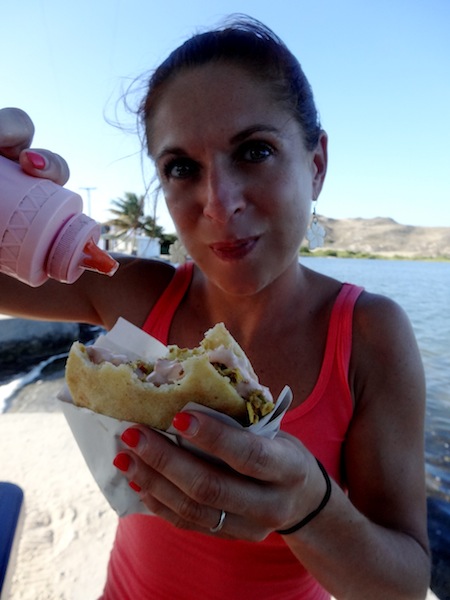
Indulging Arepas, a typical Venezuelan dish


Katherine is so excited, she is up in the air


If you are visiting Venezuela with US Dollars, make sure to negotiate the exchange rate. At the bank the rate is 4 Bolivares to $1 and in the stores you will get anything from 12 to 25 Bolivares. Therefore things can become very affordable for cruisers with foreign currency. We stock up with local beer, Solera, $11 per 24 case in can, cheapest so far in the Caribbean. Everything is made in Venezuela, even if it’s not made here, it will be labeled as if it was! 
The only hills are on the main island. They are visible from miles away and really easy to hike up to, where you get an excellent view over the archipelago. I’ve always wanted to visit Venezuela and for now this is all the taste I get from this country.

View the complete photo album of Venezuela here

Love Venezuela