Showing posts with label Colombia. Show all posts

Tuesday, May 27, 2014

Isla de Providencia

Earthling at anchor with Providencia in the background

If you like to see one of those pure and unspoiled places, then you should sail to Providencia. This Island is part of Colombia, but the locals are more of a Caribbean decent. Unlike its sister island, San Andres, almost everyone in Providencia speaks English with a Caribbean accent. People from Providencia are very proud and protective of their Island and they don’t really want it overcrowded by tourist. You can get to Providencia via San Andres by flight or a fast motor Catamaran. There is also one weekly charter flight from Medellin! Providencia is a great stop for sailors going south bound to Panama or northbound to Cayman or the bay islands. The Busch agency is the most known agent that clears in new arrival, just call Mr. Bush on Ch16 and follow instructions.

Darius and I unwrapped the bicycles and biked around the whole island in two days. There are several beaches along the western side, the biggest and most popular one is “South West Bay”. You find several beach bars and restaurant along South West Bay. “Devine NiƱo” offers the best value seafood platters! 
Biking through the Island
South West Bay
Providencia is one of those locations where Earthling crew connected with some local people. Our new friends invited us to their home, served us food, and were giving and loving!  We also got to utilize their moto bikes to get around the island. Based on my experience in the Caribbean, the less touristic islands are, the more friendly and bonding locals!

This isle is only 360m (1200ft) in altitude, but it does have a few rivers and waterfalls and there are trails that go up to the peak.
Go West
Look at the large Iguana sitting on the end of the pipe
On the South East side is Manzanillo bay, which has a large beautiful beach with palm trees hanging over the water, this bay is also known as Rolando’s Beach. Rolando has been running a beach bar here for 20+ years. Rolando is open 24/7, and you can party here till early morning hours!

One evening, on the way back from Rolando’s, we saw a house full of people and noise. The house looked like a small stadium and it sound like like there was a race. Curiousness led us in there! The race was a rooster fight! I’ve never seen anything like this live before. I think it’s brutal to fight animals, and it would not be allowed in my book. But we, humans, are still part of the animal planet and we are still fighting each other, first we have to evolve to a higher dimension and stop the fight, then I'm sure there will no longer be arranged animal fights either! However, these people were really into the fight, some flew in their roosters from other places and were betting big bucks. The fight we watched was the best! After a couple minutes of the start, one of the roosters simply chickened out and would run away and not fight, so no blood was spilled on our watch!   
Manzanillo Bay
Rolando in his favorite place
Manzanillo Beach
Cock Fight
Additionally, there are horse races on both of the beaches on midday Saturdays!
Providencia has one of the largest reef barriers in the Caribbean. Therefore, most of the locals are great fishermen and divers!
Our visit in Providencia last ten days and this island, like some other places in the past, became home and it was hard to leave it behind.
Judith, Kideson, and Chewy
Hasta a la Proxima Vez
Love from Providencia

Friday, May 2, 2014

San Andres

The Reef Barrier on the East

Earthling finally departed the Panamanian waters last week. A 220 nautical miles sail took us from Portobello to San Andres on one tack in 45 hours. The weather could not been any better, calm seas, and moderate winds were the perfect conditions especially for the inexperienced Panamanian crew, Marie Louise. I had to make sure to have a Panamanian citizen aboard to get permission to exit the waters of Colon area, smile!  
San Andres is located close to Nicaragua and Costa Rica but it’s part of Colombia. This is a vacation island and mostly visited by Latin Americans, primarily Colombians, Chileans, and Argentinians. It’s flat, sunny, windy, beautiful white sandy beaches, and lots of tourist. There is lots of activity around the main anchorage in front of the town. Jet skis and tourist boats are zooming close by without any consideration, No wake laws are absent here!
In the Background, Johnny Cay
Speed Boats
The first impression of the island was the active people. Many were running along the beach with their nice running equipment. People were biking around on racing bikes and so forth. We were surprised of how athletic people in San Andres were! The following day we went ashore and realized that there was a triathlon!     
The Board Walk along the Beach
When you check in to Colombia you must hire an agent that does all the paper work. In San Andres, the cost of hiring an agent is $80, in addition to the tourist card $25pp required by anyone visiting San Andres and Providencia. (Agent: Rene speaks a little English and can be reached on VHF16 or +57-315.680.7980, serrana_agencia@hotmail.com)  

San Andres is only 8 miles North to South and 2 miles East to West. It’s easy to bike around and explore it. Common transportation is golf carts and motorbikes. Marie and I rented a golf cart and drove around the island. On the leeward side (West) of the island, the water is calm and clear with coral lines and a perfect place for snorkeling. The beaches are mostly on the windward side.

South End
The residents of the island are mostly Caribbean with a Colombian twist. The natives speak Creole, English, and Spanish. On the radio, mixed Caribbean and Latin music is played! It feels good to be back in the Caribbean spirit!
Marie flew back to Panama yesterday and tonight Darius is flying in from Chicago. In a couple of days we are going to sail to Providencia, which should be much more tranquil. 

Love from San Andres   

Read other updates of Colombia

Sunday, February 16, 2014

Learning Spanish / Aprender Espaniol

There are so many ways to learn a new language. My new goal is to be more or less fluent in Spanish. This language is widely spoken in Americas. I like to learn Spanish because everybody looks at me as if I should speak Spanish! I remember some people in Puerto Rico and DominicanRepublic were taking it personally and getting upset because I didn’t speak their language. They thought I was from hispanic decent but grew up in the U.S and never got to learn Spanish.

The best way to learn is to be in a Spanish-speaking environment. Last year in Colombia, my Norwegian cruising friend and I took some private classes in Spanish. We found a good teacher in Cartagena and took 2 hours classes, 5 days a week, for one month. The note book from that class is my Spanish Bible. Nowadays, there are so many other sources for learning a new language, such as apps on your electronic device. The best Spanish learning app I found is "Duolingo". It’s so easy to learn a new language through this application. In addition, when you get to advanced level and formulate new sentences, Duolingo applies those sentences and translates the Wikipedia and other documents to Spanish. Another useful app is “Translate”, which is just a regular multi language dictionary but very easy to switch between different languages. And then there are audiobooks that you can play all day while cruising on your boat.
Aboard Earthling, we also have Spanish for dummies and cruisers, and Spanish music, such as Julio Iglesias and Gypsy Kings. Moreover, a good way to end a hot sunny day on the boat is to watch a Latin movie with subtitle. 
Between all these sources, one should be able to learn a new language quickly. But the most important criteria to learn a new language is Self-Discipline! 

If you find yourself in Cartagena and need private lessons in Spanish, contact Lu Rodriguez at clasedeespanollu@gmail.com

El Amor De Panama


Sunday, June 23, 2013

Colombia-Panama Passage

The last overnight passage for this season brought Earthling from Isla Fuerte, Colombia to Isla Pinot, San Blas, Panama. I have to admit it was the least tranquil passage this year. Earthling departed Isla Fuerte with very little winds & waves at 11 in the morning.

We always troll a fishing line during the day. A fish was following and nibbling on the lewer on and off. But this fish was different, it was of a dark color with its top fin sticking out of water. Could it be a shark? After an hour of her following us, suddenly the reel started to spin really fast, 40ft of fishing line went out in no time. The fish jumped up in the air twirling and twisting around and boom snapped a favorite lewer. Indeed, it was a shark and there is no way we would bring a shark aboard. There are many horror stories of people trying to reel in sharks, their meat is delicious but not worth the work for us. Afterward, two more bait were put out, one of which sprayed with WD-40 (WD-40 contains fish oil). Within a short period of time both of the lines got something on them, one snapped off again by another large cold blooded aquatic creature and the one with WD-40 brought in a good size yellow fin Tuna. The tuna was cleaned and we had a few fillets for dinner right before sunset.

Winds started picking up as the sky was turning dark. Not so many boats are encountered in these waters.  However, we saw a large vessel in distance, Colombian Coast Guard. Shortly after we sight them, they contacted us on the VHF radio and asked the normal questions; flag, boat name, number of crew, last port of call, next port of call, nationalities and so forth. They thanked us for the cooperation and we were clear to continue.

The autopilot is steering the boat and unexpectedly starts making some strange sounds and had to be disengaged. Now the boat has to be steered manually overnight. Winds are stronger, we are on the second reef and still doing speeds between 6-7 knots on a beam reach with occasional ten-footers clashing on the starboard side. Katherine is motion sick in these conditions! Around eight o'clock at night, in the middle of nowhere, we realized a boat is trying to catch up to us in a fast speed. All kinds of thoughts are in mind, primarily pirates! As the boat got closer, its blue bright sirens went on! We contacted the coastguard right away and was wondering what their intentions were? It took several slow minutes before we heard back from them; it's an inspection procedure, reduce speed and get ready to be boarded. It's a little scary to have people come aboard your boat under way at night. But we cooperated, furled in the genoa and started the engine. There were five men dressed in uniform on the speed boat. They tried to come to port side and board Earthling, but these waves were not making it possible. After a few attempts, they end up taking pictures of the boat as we tried to have a sense of humor and smile. They informed us that everything is sound and there is no need to come aboard, thanking again for cooperating and noting they are here if we need any assistance.

Attempts were made to fix the autopilot under way but it seemed like the belt inside was broken. I had to be behind helm the entire moon less cloudy night as heat lightnings were striking in the skies over the ocean. The boat was washed over several times as of which once the cockpit got filled with water. While starring at the compass to keep the course on 262, I'm thinking, why in the whole world am I putting my self through this? I can't wait to see the day again and arrive at a new land.
It's 5.15am, we are five miles off Isla Pinot (Tupbak) and it's still dark. After 40 min of drifting with minimum sails, the sky starts to brighten up. We see land, the best sight one can imagine!
And here we are anchored by the Darien tropical rainforest in the land of Kunas. Perhaps this is why you have to go through difficulties in order to get somewhere rewarding, once again we found ourselves in paradise.

The untouched dense green mountains are on one side and the Kuna village on the other side of the anchorage. It looks like nothing has changed here for a long time. These earthlings are the most primitive ever witnessed. Isla Pinot or Tupak is a small Kuna village on a large island. It's significant since it has the highest elevation out of all the islands.

Katherine in front of the Village of Tupak
Earthling anchored between the Darien forest and Tupak
Prudentio brought us Kuna bread
Typiacl Kuna houses

Love from San Blas

Monday, May 13, 2013

Islands of Colombia

Before setting sail to San Blas, Panama, we explored more of the Colombian Islands. A picture update is better than thousands words. After Cartagena, Earthling anchored off Isla Grande, Isla Tintipan, and Isla Fuerte. These Islands are part of the Islas Rosario and and Islas San Bernardo Archipelago. We did not encounter any cruisers in any of these islands!     

Isla Grande, Del Rosarios

It’s fascinating how these houses are built on top of reefs

Palmar in Isla Grande has several hundred different species of birds. Lots of parrots are roaming free on the Island.


This dog followed us around Isla Grande and became very attached to us and vice versa. When we left back to the boat on the dinghy, it didn’t take long before she jumped in the water and swam to Earthling. We put her in the dinghy and fed her, but I had to take her back to shore and with a firm voice tell her to go home. I love dogs but don't have the space for one! 
Pacha
Pacha sleeping in the Dinghy
Isla Tintipan is the most quiet, calm, and deserted anchorage with the least amount of souls around


Isla Islote Santa Cruz is the world’s most populated Island per square foot. 1250 ppl live in 90 houses on one acre of land


In Isla Fuerte they build their own paddle boats from logs of big trees. The nature is tropical with many fruit trees.


Typical House in Isla Fuerte
He was happy to give us some mangos
Home Made Canoe
Anybody looking for a boat to Cruise on :-)
Love from the Islands in Colombia

Wednesday, May 1, 2013

Road Trip in Colombia


It was almost two months ago when Earthling entered Colombian waters, since moving along the coast and with Katherine arriving nearly two weeks ago, we were eager to venture inland to see the real country of Colombia. An opportunity came up to rent a car so we decided to take a road-trip and explore the North Western part of the country. Road-trips are another favorite way to travel the world. Starting from Cartagena, we drove 300km to Valledupar to visit our friend Paola for the weekend. From there we continued North towards Riohacha, down the coast through Santa Marta, up the mountains into Minca, over the rivers and swamps outside of Barranquia and back to Cartagena. In five days a total distance of 1200km (750miles) was traveled.

A road-trip in Colombia is fun and yet adventurous but it's not as easy as if one were in the U.S or Europe. Rental cars can be expensive since its not a custom to drive or own a car here. One can rent a newer compact car from a major company for around $110 a day with limited mileage or an older car is available from an owner operated car rental for $55 a day with unlimited mileage. The second option is more economical but comes with a higher risk and you might not get any assistance if you have mechanical problems while driving cross country.
Mountains Outside Valledupar
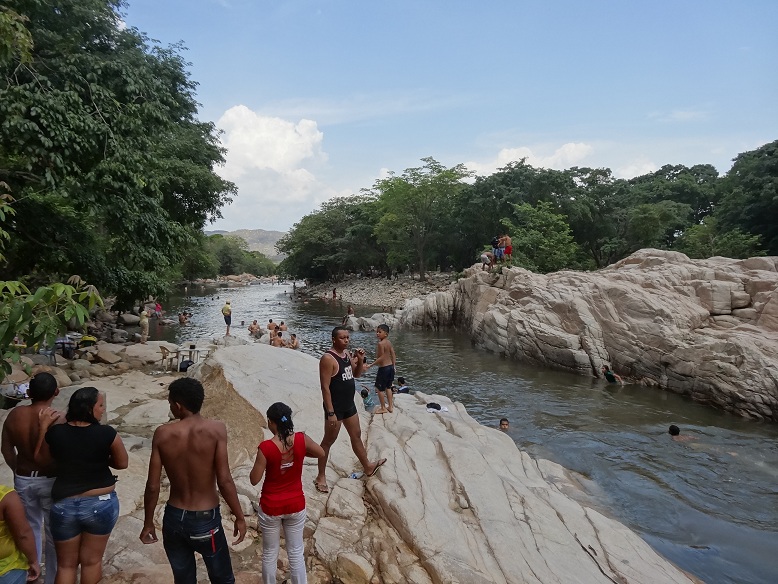
Valledupar is located on the East side of the Sierra Nevada Mountains. The climate here is much different than the costal cities; less humid but more rainy than Cartegena. Our friend Poala suggested we visit a few of the many rocky rivers outside Valledupar. Katherine, Paola, and I spent a whole Sunday exploring these rivers and its vast nature. At the end of the day as we are driving back, our Red Chevy Aveo started making some unusual sounds. I recognized these noises when the car was picked up but now they are only getting worse. After returning home, Paola called and informed the car owner assuring him the car was OK, but there might be an issue with one of the rear wheels. The owner's response was that the car had been checked, mechanically sound and in good shape when picked up, so if any problems arise, it is the driver's responsibility!


Local's hangout by the rivers 


The following day, Katherine and I left Valledupar continuing on toward Macao and then Riohacha. At this point we are trying to be very gentle with this car, driving cautiously over speed bumps and potholes and going no more than 70km/h (40mph); hoping the car will make it back to Cartagena but it's a long way home! At this point we are debating to continue on to Macao as planned or take a detour to Riohacha but the universe made the decision for us, leading us on the road to Riohacha instead. We are now in the middle of the desert passing through a few small Native American Indian villages in the state of "La Guajira" when we hear a strong friction coming from the left rear axel. The noise is so bad we are forced to stop because the wheel will no longer rotate. It must be the wheel bearing! But how in the world are we going to find a mechanic in the middle of nowhere that can replace a bearing? Leaving no choice, I jacked up the car, removed the rear tire and brake rotor, located the wheel bearing and sprayed the heck out of it with WD-40, until there was a smooth consistent rotation. Thanks to WD-40, this quick fix got us going again! However our new concern is how much longer can we go before the lubrication dries out? Believe it or not, this little "city car" made it another 120 km (80miles) to the skirts of Riohacha before it stopped again, at sunset. The same procedure was performed, however this time we got lucky and a tow truck driver nearby happened to have grease (WD40 heats up with friction but grease is more tolerant with heat and better in this case). In need of a mechanic, we stop at the first gas station to find the person we asked was a owner of a mechanic shop just across the road. It was too late to get a new bearing, so the car was at the shop overnight and the owner, Evardo gave us a lift to a nearby motel. The following day the car was repaired and we were ready to take off again! Thankfully labor and parts are reasonable in Colombia and it didn't cost more than $60 for the whole thing. Thereafter we contacted the rental company and got to keep the car one extra day instead of getting reimbursed for the repair.

Riohacha is a small coastal city and the first port you can check into, coming from North on a boat. This city is mostly populated by Native American Indians. Their high quality hand crafted bags, hammocks and jewelry are sold by native artists or at street vendors for half of what it would cost in Cartegena. Through out this trip, we noticed that every village had something to offer, anything from tropical fruits to gasoline from Venezuela, fresh fish caught from the local river or our favorite, a shot of black "Colombo Cafe" all available on the road side. The car was filled up with gas four times, out of which, two times gas from Venezuela. A gallon of fuel costs around $5 per gallon at any gas station but on the side of the road close to the Colombia-Venezuela border, you can find it for as cheap as $2 per gallon!
Bags made to last life time
Cheap Gas Drive Thru

Homemade Jelly from Nearby Village  
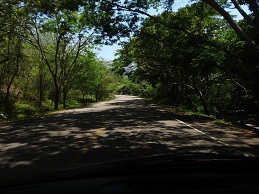
On to Tyrona National Park area some of these roads felt like tunnels, since the large trees acted like canopies over you. The routes throughout this part of Colombia are mostly trafficked by busses and trucks. Furthermore they are highly controlled by police and military. At these roadblocks you must drive slow and be prepared to stop. You might be asked to show car documentation or searched. This happened to us twice and we kindly cooperated. After the first day, we learned how to make the smooth pass through security check points. All you have to do is SMILE, make eye contact and give the "thumbs up signal" for a smooth pass.

We arrived at Tyrona National Park just shy of the gates closing time at 5pm. Now realizing it's almost dark and we have no dinero and no plans. With a quick run through Santa Marta we hit an ATM and grabbed some street food. Neither Katherine or I wanted to spend the night in the city and were determined to wake up in the Mountains. There is only one road available at this time up to Minca. Don't try this at home folks! As crazy as it sounds we continued to drive an hour up the mountains on half paved roads with no signs. It's not really wise to travel up elevation in Colombia at night with a small city car that is not made to go off-road, let alone broke down earlier that day! As Katherine and I are having this discussion, in the middle of the darkness in the jungle, she starts to feel sick and is possibly food poisoned from the street food. She emptied her stomach on the side of the dirt road as dogs from close by houses were barking at us. At this point, I'm very concerned and don't know if we should turn around to Santa Marta or continue to Minca. We don't even know if there will be a place to sleep once we get there. Our intuitions pointed up the mountain and worst case scenario we sleep in the car!

We got to Minca at 21:30 to find it a ghost town, nobody was around and nothing open! We drove into the Minca Hotel hoping for someone to be there but no luck. I parked the car, leaving Katherine to rest and started walking to find something......anything! I'm nervous and concerned and asking the higher power to open a door. Miracously, within a few minutes, there was another quaint Hostel but the gate is locked and a dog is sitting by it. I'm hoping the dog would bark, so the owner comes out, but she continues to sit quietly and wanted to be pet.

All the lights were off, but a tv seemed being on in the house. I shake the fence a little bit and started talking to the dog and a gentleman peaked out from the second floor. Fernando, the owner of "El Mirador" came down the stairs and in broken Spanish I asked if it's possible to get a room. He unlocked the gate and invited me with open arms. Fernando offered us a room with a spectacular view over Santa Marta. This building is vacant of guests, leaving the whole place just for us. While I went to get Katherine and drive the car up the tiny steep dirt road, Fernando had woken his wife and the two were preparing dinner for us. This couple were so hospitable, friendly, and giving that made one emotional. Within a short time we found ourselves in paradise, it was a miracle.
Santa Marta at night
Fernando and I
The following day we went to "La Victoria" Coffee plantation build in 1892.  This plant was still in operation with the same original machinery imported from UK and the US. Three different generation of people were working here, Yeimi was our tour guide, her father was working as an engineer, and her grandfather was the plant manager. They all lived within close proximity to La Victoria.
Last time I visit Minca, we went to an amazing tranquil water fall and this time we dip ourselves in cold fresh water by another beautiful waterfall. The visit in Minca topped off the highlights of this road trip.


Road to La Victoria
La Victoria Coffee Plantation


Another few days in Cartagena and we are ready to set sail toward San Blas, Panama. My cruising friend Marius aboard "Chiron" is hauling out in Cartagena and going back to Norway and our paths are separating for now. Some electronics on the boat are on their last breath and destroyed by the salt and humidity, lets hope they make it till end of this leg.

Love from Colombia

View the complete photo album of Colombia here